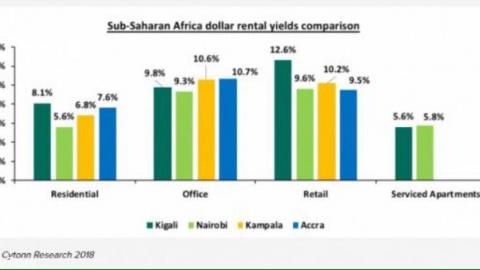
Kigali has higher rental yields than any other key cities in the residential and retail sector in Sub-Saharan Africa, a recent study shows. Rental yield is the rate of income return over the cost associated with an investment property, typically expressed as a percentage.
Kigali has higher rental yields than any other key cities in the residential and retail sector in Sub-Saharan Africa, a recent study shows.
Rental yield is the rate of income return over the cost associated with an investment property, typically expressed as a percentage.
Kigali has an average rental yield of 8.1 percent for residential real estate and 12.6 percent for retail and 9.8 percent for office with rental yields.
According to the report by Cytonn Investments, Kigali outperformed markets in bigger economies such as Nairobi, Kampala, and Accra.
Kigali is the smallest city among the cities surveyed with a population of about 1.2 million against Accra’s 2.4 million, Nairobi’s 4.1 million and Kampala’s 1.8 million. Among the key drivers of the high performance in returns include government’s incentives largely driven by investments in infrastructural expansion, modernization of urban infrastructure, including construction of roads and provision of utilities such as water and electricity in development sites.
Other drivers of the high rental yields include a housing deficit demand of 16,923 affordable dwelling units per year, according to estimates.
The report’s authors further attributed the value to population growth, at 2.4 percent, compared to the global average of 1.2 percent.
Economic growth and development in recent years was also found to be a factor of the yields.
Rwanda’s economic growth exceeded the previously projected 5.2 percent to grow 6.1 percent last year.
The report also cited Political stability with well-functioning institutions, rule of law and zero tolerance to corruption.
The urban population in Rwanda is estimated at about 30.7 percent of the total population while the urbanization rate stands at 4.9 percent per annum, hence creating increased demand for real estate developments.
Despite the returns in the local real estate, the report’s authors cited major challenges that have discouraged potential investors such as high costs of construction (due to the importation of most materials), high cost of financing and low purchasing power.
“Funding real estate developments has resulted in excessive debt financing, with a debt interest rate, ranging from 17 to 19 percent per annum on the Rwandan franc.
The market also does not embrace presales but rather prefer to buy after completion of the project or sometimes during the construction. In addition, Rwanda Development Bank is the only main lender providing development loans.
“The high mortgage rates make it hard for Rwandans to borrow to finance the purchase of houses given the low levels of income,” the report adds.
Real estate services, such as individual homes occupancy or sales on homes occupancy, grew by 5 percent in 2017, putting the share of real estate to the entire national GDP at 8 percent, according to the National Institute of Statistics of Rwanda (NISR) figures released last week.
The sector was the major contributor to the service industry’s 46 percent expansion during the reporting period.
Source: The New Times


