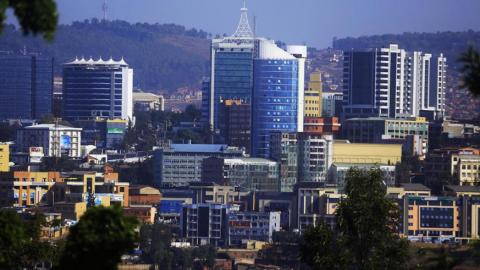
Downtown Kigali. The 10 percent growth in industry sector was mainly driven by manufacturing and construction activities. Sam Ngendahimana.
Rwanda’s economy grew by 6.7 percent in the second quarter of 2018, the Ministry of Finance and Economic Planning said yesterday.
The performance represents rebound from the 4 percent growth rate registered in the same period last year
In the second quarter of 2018, Gross Domestic Product (GDP) at current market prices was estimated at Rwf 2,000 billion, up from Rwf1, 869 billion in the second quarter of 2017.
According to the National Institute of Statistics of Rwanda, which jointly released the GDP figures with the Ministry of Finance, the positive growth was a result of growth in all the three key sectors of the economy.
The three sectors are agriculture, which grew by 6 percent, industry that grew by 10 percent, and services that grew by 5 percent.
The Minister for Finance and Economic Planning, Dr. Uzziel Ndagijimana, said that the economic growth posted reflects hope that the country will achieve the 7.2 percent economic growth rate targeted for this year.
“It’s good growth; we see good performance in all the three sectors of the economy,” he said at a media briefing at the release of the GDP figures at the ministry’s head office in Kigali.
The growth in agriculture sector was mainly attributed to growth in food crops and export crops, with food crops growing by 6 percent in season A, while export crops grew by 6 percent mainly due to tea and coffee production.
The growth in industry was driven by manufacturing and construction activities which expanded by 12 percent and 11 percent, respectively.
Food processing, which was characterized by increased processing of cereals, tea, coffee, and sugar were the main drivers of growth in the manufacturing sector.
The statistics body also said that the production of textiles, clothes and leather goods increased by 13 percent, while production of construction materials, such as metallic products increased by 37 percent.
It said that construction is picking up its momentum with an increase of 11 percent in the second quarter of 2018 following an increase of 8 percent observed in the first quarter of 2018.
Minister Ndagijimana described growth in the industrial sector as an expected result from the Made-in-Rwanda campaign, which has sought to promote domestic production.
“Manufacturing is growing through different measures to promote domestic production and manufacturing under the Made-in-Rwanda policy,” he said.
As for the growth in the services sector, it was due to growth of several activities, including wholesale and retail trade that increased by 11 percent due to increase in tradable agricultural and manufactured products as well as transport activities that increased by 13 percent boosted by air transport that increased by 17 percent.
Growth in the services sector was also fueled by information and communication activities that increased by 18 percent, financial services that increased by 7 percent, as well as public administration activities that increased by 4 percent.
“The high increase is due to the fact that last year’s growth was very low,” the Deputy Director General of the National Institute of Statistics of Rwanda, Ivan Murenzi, said.
The economy is projected to grow 7.2 percent this year, up from the 6.1 percent posted last year.
Source: The New Times


